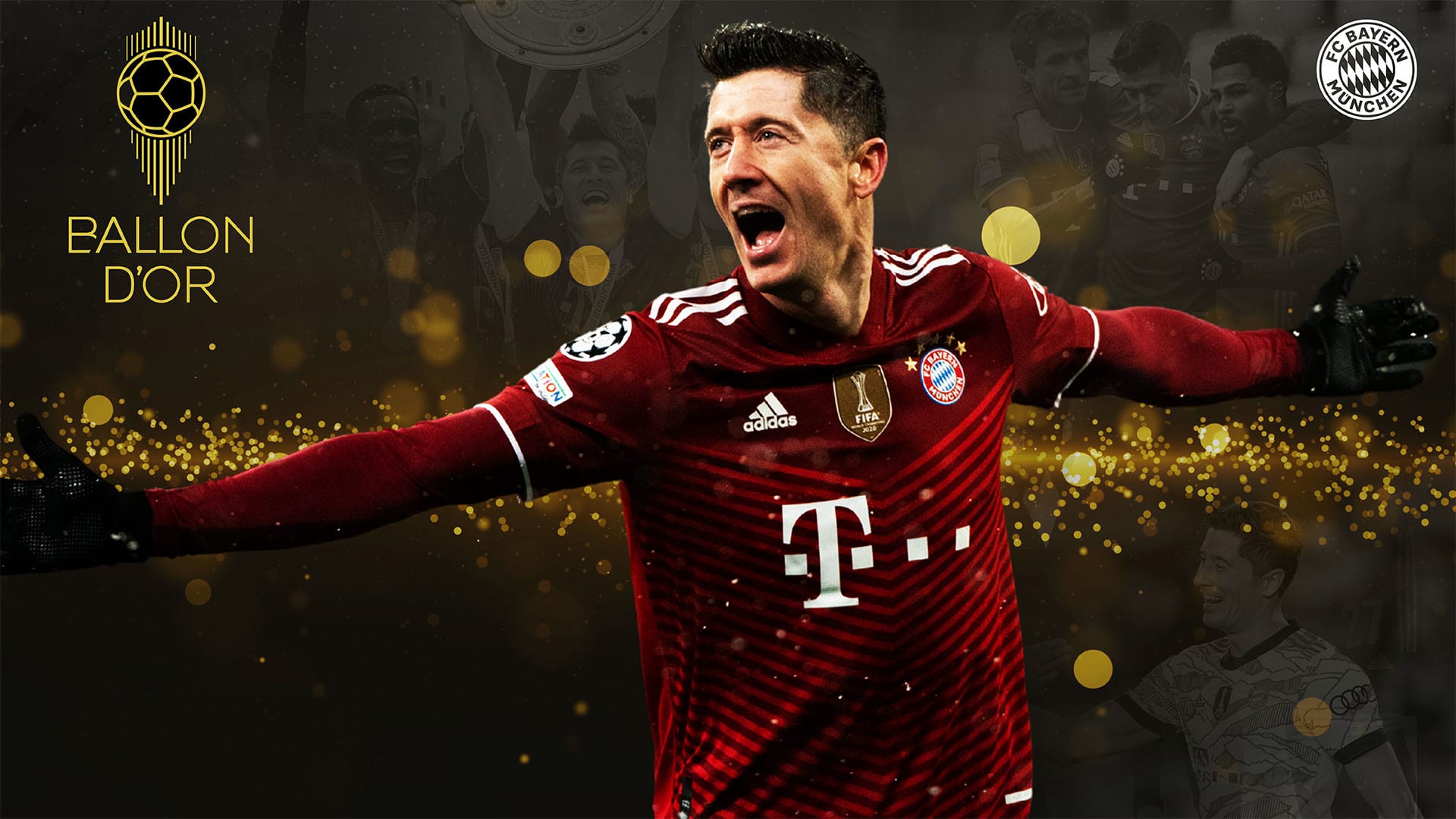
Lewandowski dreams of a retroactive Ballon d'Or win.

Between 2020 and 2021, Robert Lewandowski had the most successful period of his career with FC Bayern. However, the Polish international did not win the Ballon d'Or. However, there are suspicions that the 2020 prize will be handed retrospectively. Lewandowski has not lost hope in this regard.

Even at the age of 35, Robert Lewandowski maintains an impressive goal-scoring record. This season, the Barça attacker has 20 goals and nine assists in 43 competitive appearances. However, the striker unquestionably had his best years at FC Bayern.

Lewandowski also sees it this way. He told Sport BILD that 2020 and 2021 were the best years of his career. A friend recently texted me this statistic: "I scored 100 goals in 85 games." In both years, the Pole was named FIFA World Player of the Year, but he was denied the Ballon d'Or.

Retrospective honor for Lewandowski? 

However, there are now suggestions that the 2020 prize may be handed retrospectively. Regardless of the delay, Lewandowski would be pleased with the honor. "Of course, I would have hoped to get the Ballon d'Or prize someday. I'm neither furious or sad since the trophy is still absent. But I believe it would have been my time in one of the two years."

The former Bayern Munich player went on to say, "I've heard there are rumors about a retrospective award for 2020." This year was fantastic for me; I was at my peak performance, and we won everything. Let's put it this way: if I were to win the Ballon d'Or 2020 four years later, I would not be offended; it would be a wonderful honour, and I would embrace the prize.

The prize was canceled in 2020 due to the coronavirus, but all associated competitions continued to take place. At the time, only the French Ligue 1 had concluded its season prematurely. That year, Lewandowski helped Bayern win the treble and was named the season's best player. 


Comments

Popular posts from this blog

Didier Deschamps Departs: A Look Back at His Legendary 14-Year Reign with France.

Didier Deschamps walking away from the France job after 14 years feels less like a simple coaching change and more like the closing of a chapter in football history. His reign did not just bring trophies; it rewired the identity of Les Bleus, dragged the national team out of chaos, and turned France into the sport’s most reliable tournament machine. Looking back on his era means retracing a journey from crisis management to dynasty building, from the scars of past meltdowns to a culture defined by discipline, unity, and ruthless consistency. When Deschamps took charge in 2012, France were not the serene giant we now take for granted. The memory of the 2010 World Cup fiasco still hung in the air – the player revolt, the fractured dressing room, the sense that the blue shirt had become a magnet for ego clashes rather than collective ambition. There was talent, but it was scattered and unfocused. Deschamps arrived as a former captain who had already lifted the World Cup and the European C...

Manchester United's 2026 Midfield Revolution: How Santos and Tielemans Will Redefine the Team.

Manchester United’s 2026 midfield rebuild feels less like a routine squad adjustment and more like a statement of direction. If the club truly intends to move from inconsistency to control, then pairing a dynamic ball-winner like Santos with a polished operator like Tielemans could reshape the team’s identity in a way United have badly needed for years. The bigger question is not whether they are talented enough, but whether their arrival can finally give United a midfield that feels modern, balanced, and reliable. For too long, United’s midfield has lived in an uncomfortable middle ground. At times it has been too open, too easy to run through, and too dependent on individual moments rather than collective command. At other times it has been too cautious, slowing the game down without creating enough threat. The best teams do not merely fill midfield slots; they build a central engine that determines how the entire side behaves. That is exactly why the Santos-Tielemans combination mat...

Will Expanding the World Cup to 64 Teams Dilute Football's Integrity?

The idea of a 64-team World Cup sounds, on paper, like a celebration of football’s global reach. More nations would get the chance to experience the tournament, more fans would see their flag on the biggest stage, and more stories from outside the traditional power centers would enter the world’s football conversation. But beneath that sense of inclusion lies a serious question: can the World Cup grow without losing the competitive sharpness, sporting balance, and emotional intensity that made it the most powerful tournament in football? In many ways, expanding to 64 teams could widen the event’s footprint while narrowing its meaning. The World Cup has always been more than a tournament. It is a global ritual built on tension, scarcity, and the feeling that every match matters. Part of its magic comes from the fact that qualification is hard, entry is precious, and the final tournament feels exclusive enough to carry real weight. When the field expands too much, the event risks changin...

The Great Managerial Exodus: 16 National Team Coaches Depart Amid Tournament Turmoil.

The story of FIFA World Cup 2026 is not only about goals, upsets, and tactical battles. It is also about collapse at the top, where pressure became so intense that 16 national team coaches walked away, were dismissed, or simply could not survive the chaos of the tournament. That scale of turnover is remarkable even by football’s brutal standards, and it tells us something important: this was not just a tournament of bad results, but a tournament that exposed the limits of managerial control on the world’s biggest stage. When coaches begin falling one after another, the signal is larger than individual failure. It points to a competition where expectations are inflated, margins are microscopic, and the emotional cost of one defeat can become unbearable. At a World Cup, managers are judged not only on whether they win, but on whether they make a nation feel convinced, calm, and capable of resisting pressure. In 2026, that burden seemed to crush more coaches than usual. The result was a m...

Why Portugal's Star Midfield Failed to Shine at FIFA World Cup 2026.

Portugal entered the FIFA World Cup 2026 with one of the most admired midfields in the tournament, yet they left with a sense of underachievement that felt bigger than the result itself. On paper, the balance of experience, creativity, and control looked strong enough to drive a serious title challenge, but the team never consistently turned that talent into dominance. The disappointing truth is that Portugal’s midfield did not fail because the players lacked quality; it failed because the pieces never fit together in the way elite tournament football demands. The biggest problem was that Portugal’s midfield became too safe at exactly the moment it needed to be brave. Too many sequences felt controlled but harmless, neat but not threatening, patient but not penetrating. Possession was often maintained for its own sake rather than used as a weapon to unsettle opponents, and that made Portugal predictable in games where the margins were tiny. A team with this much technical ability shoul...