
Colombia survived a furious semi-final against Uruguay, revealing three key takeaways.

Colombia defeated Uruguay 1-0 on Wednesday, securing a spot in the Copa América 2024.

This is what we created from the action.

Colombian dark horses are no more.


The only statistic you need to appreciate how powerful this Colombia team is is that they have extended their unbeaten record to an incredible 28 games.

Néstor Lorenzo's crew have refined their recipe and show no signs of slowing down.

Colombia were brave throughout the match against a strong Uruguay team that carried the always-heavy favourites tag into the tournament, despite being a man down for the entire second half.

Colombia has established a new record for the longest unbeaten streak in the national team's history:

WWWWWWDDWWWWDDDWWWWWWWWWWDWW

Los Cafeteros will defend their 28-game winning streak against Argentina in the 2024 Copa América final.

This is their first final in 23 years.
  

Their success is partly down to James Rodriguez, who has turned the Copa América into his personal stage to showcase his talents. With his help, other talents have evolved to shine and produce when it counts the most.

Colombia is presently in their third Copa América final, having last won the competition in 2001. Daniel Muñoz's absence in defense will be a significant loss, but the club has demonstrated exceptional teamwork.

A night to forget for Núñez.
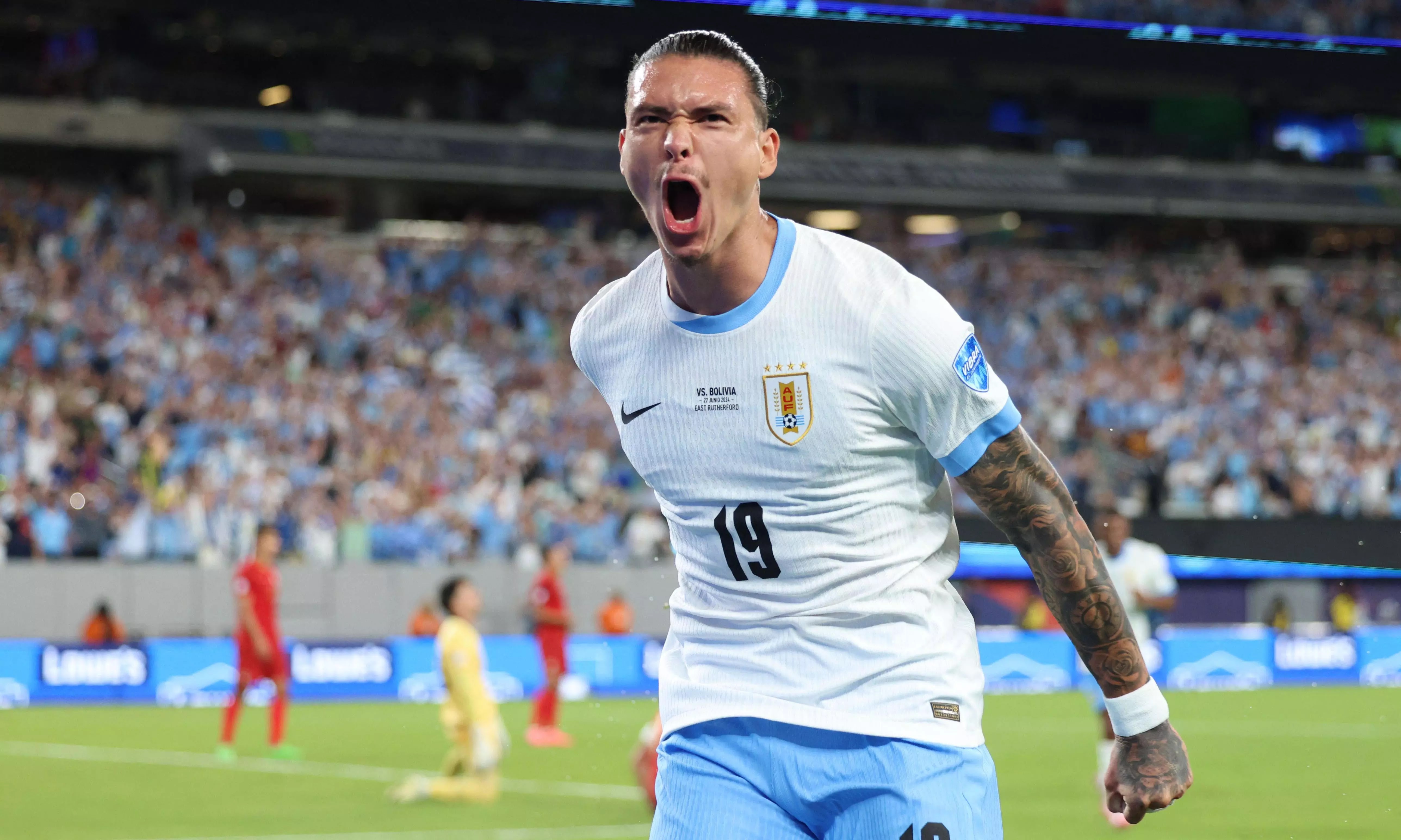

Darwin Núñez, a regular goal-scorer in the Premier League, did not contribute to Uruguay's victory over Colombia.

The Liverpool star demonstrated his ability to strike the ball wonderfully and with blistering power, but none of his three first-half tries found the net.

Unfortunately for him, none of his attacking partners, including Federico Valverde, Facundo Pellistri, or Luis Suárez, could motivate him to provide a spectacular performance.

Darwin Núñez has tried the most shots in the Copa America. What is the verdict?  


Following the game, Núñez was caught striking Colombian fans in the stands, escalating the situation.

The scene will almost certainly frustrate both manager Marcelo Bielsa and Liverpool manager Arne Slot.

International football reigns supreme.


This summer of football has definitely delivered for fans all across the world, and Wednesday night's performance was especially impressive.

A semi-final featuring two South American heavyweights with lethal attacks, midfield wizards, and dominant defensive lines that pull out all the stops.

In truth, the presentation on exhibit was worthy of a final. It was an electrifying start from the off, with both teams hustling and opportunities keeping supporters on the edge of their seats.

Uruguay 0-1 Colombia (FT)
Long live James Rodríguez's left foot
Long live defending a lead with 10 men
Long live Colombia's unbeaten streak
Long live Copa nights.


Goalkeepers Sergio Rochet and Camilo Vargas were kept on their toes, occasionally pushing last-ditch efforts against the woodwork as emotion spilled out onto every inch of the pitch. A red card for an elbow to the breast added to the excitement before the subsequent mob scenes.

Another great example of how international football reigns supreme. Bring on Sunday's finale!

Comments

Popular posts from this blog

PSG's High Valuation: Will Liverpool's Strategy Work for Barcola?

PSG’s high valuation of Bradley Barcola turns this transfer chase into more than a simple bidding contest; it becomes a test of whether Liverpool can translate smart strategy into a deal that still respects the brutal economics of elite football. The club may believe Barcola is the right successor to the wide threat they’ve lost, but the question is whether their approach can persuade PSG to bend on a number that currently looks designed to intimidate as much as to value the player. At the centre of the story is a familiar modern transfer tension: Liverpool want a player who fits their tactical future, while PSG want to be paid for both current quality and future potential. Barcola is young, already proven in elite competition, and has the kind of explosive wide profile that top clubs rarely let go cheaply. PSG’s reported figure — around €170m or £145m — is not just a reflection of his ability, but of how they view his ceiling, his age, and the leverage they believe they hold because h...

How Juventus' Loan Deal for Randal Kolo Muani Could Shape Their Future.

Juventus’ loan deal for Randal Kolo Muani could shape their future because it is not just a short-term striker solution; it is a test of how the club wants to build, spend, and compete over the next several seasons. A move structured as a loan with an obligation or pathway to buy shows Juventus trying to balance immediate sporting need with financial caution, and that combination may end up defining the next stage of their project. At a basic level, the deal makes football sense. Juventus have wanted a forward who can stretch defences, attack space, and bring vertical threat without requiring the team to be rebuilt around him. Kolo Muani fits that brief because he gives them pace, movement, and directness, while also offering enough technical quality to combine in tight areas. When a club like Juventus, which has historically valued control and efficiency, chooses a striker with his profile, it tells you the team wants more than a reference point up front. It wants a weapon that can ch...

The Infantino Ultimatum: How a Proposed $4.2 Billion Sale Threatened to Divide Global Football.

Gianni Infantino’s proposed $4.2 billion sale has done something rare in global football: it has united people who usually disagree for very different reasons. By pushing a plan to sell a minority stake in a new FIFA commercial vehicle tied to the World Cup’s revenues and rights, he has triggered a reaction that is not just about money, but about power, ownership, legitimacy, and who gets to decide what football is allowed to become. At the centre of the controversy is FIFA’s plan to create a new subsidiary — widely described as FIFA Forward Enterprise — that would oversee commercial operations linked to the men’s and women’s World Cups and the Club World Cup, with outside investors buying a stake of up to about 20%. FIFA says the move could raise as much as $4.2 billion immediately, while valuing the new company at around $20 billion, and it insists that governance, competitions, and sporting decisions would remain entirely in FIFA’s hands. On paper, that sounds like a neat separation...

Valentín Barco's Journey: From Brighton to World Cup Finalist and Now Chelsea.

Valentín Barco’s path to Chelsea is one of those modern football stories that looks messy from the outside but makes complete sense once you understand the player behind it. He did not arrive in West London by following a straight line. He came through Boca Juniors, had a brief and awkward stint at Brighton, rebuilt his reputation in loan spells, matured into a more versatile and tactically complete footballer at Strasbourg, appeared on the World Cup stage with Argentina, and only then earned the move to Chelsea. That journey matters because it shows why this signing is about much more than raw talent. It is about development, reinvention and the way elite clubs now search for players who have already been tested by failure as well as success. The first part of Barco’s story is the one that makes him so intriguing to Chelsea in the first place: he has never been a conventional prospect. Making a professional debut at 16 is not normal, even for elite academies, and Barco’s rise at Boca ...

The Rise of Giulia Dragoni: How Chelsea's New Signing is Shaping the Future of Women's Football.

Giulia Dragoni’s move to Chelsea feels bigger than a normal transfer because it captures a very clear shift in women’s football: the best young players are no longer being treated as future promises alone, but as immediate pillars of elite projects. Chelsea are not signing her just because she is talented. They are signing her because she already looks like a footballer capable of shaping a team’s identity at the highest level, and that tells you a lot about how the women’s game is evolving. The first thing that stands out about Dragoni is how early she entered the elite conversation. Making her senior Italy debut at 16 and appearing on the World Cup stage at the same age gave her a kind of visibility that most players do not get until much later. That matters because it means she has spent her teenage years already being evaluated as a high-level performer, not as a developmental curiosity. She has had to learn quickly how to handle scrutiny, expectations and the pressure of being lab...