
5 Things We Learned from Wednesday's UCL Action.

The second night of the new Champions League season was less tumultuous than the first, but there were still plenty of discussion points.


These are the best among them.

Inter demonstrates their class versus City.
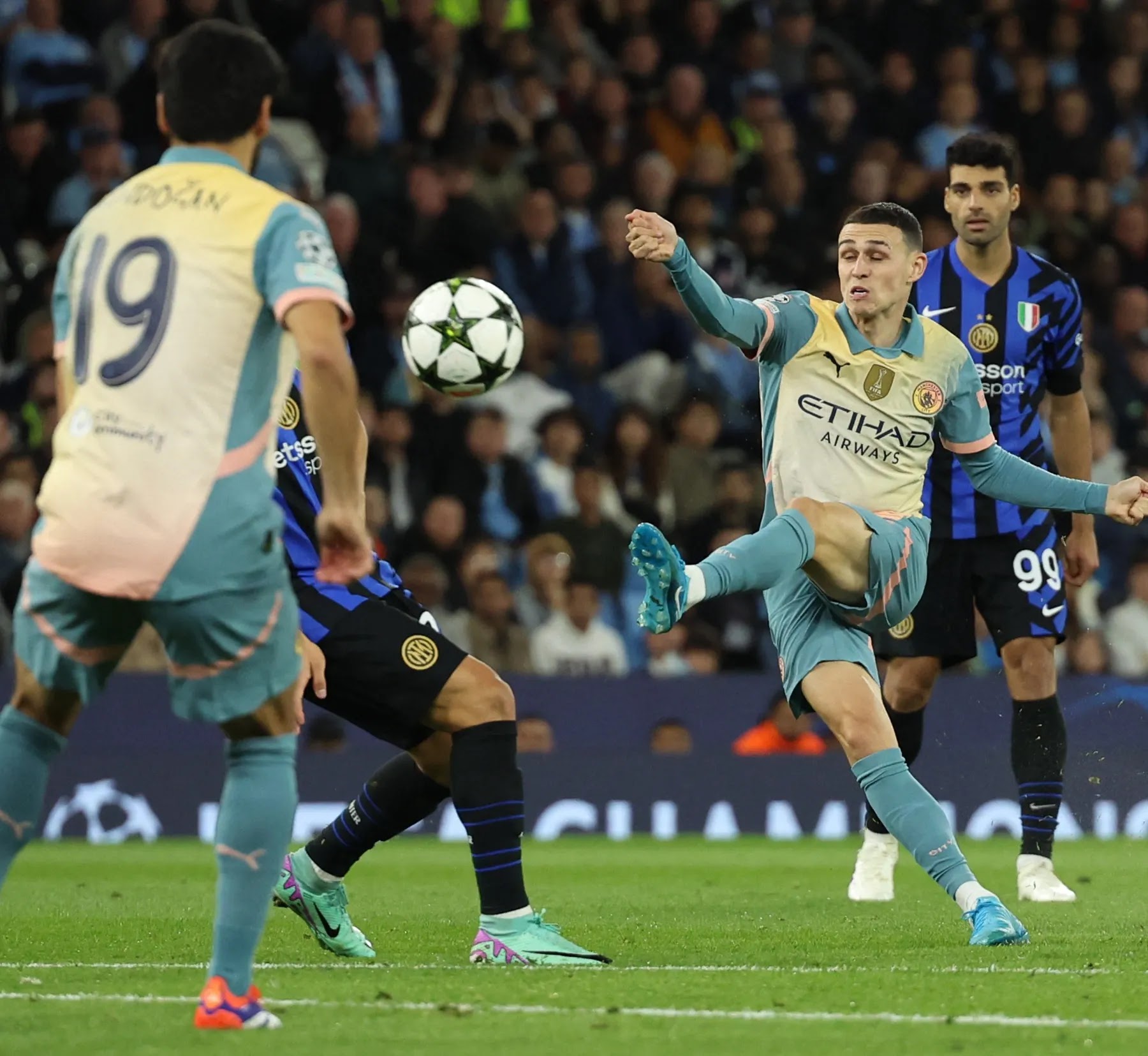

In the previous 41 Champions League games at the Etihad Stadium, only one visitor team had kept a clean sheet, but Inter did just that tonight.

The Serie A winners defended admirably throughout, limiting Erling Haaland to only one serious chance and appearing mostly at ease in the process.

That is not to argue that the three-time European Cup winners lacked opportunities. Inter created some fantastic opportunities, both in general play and in some deadly counterattacks. Marcus Thuram and Matteo Darmian should have done better in front of the goal.

Simone Inzaghi's brave decision to sit captain Lautoro Martínez proved successful, with Nicolò Barella relishing the opportunity to test himself against Rodri and company.

Inter's performance and result should not have surprised anyone, especially Pep Guardiola, given how close they came to beating City in the 2023 final.

Based on tonight's performance, they are very much a contender again, and unquestionably the finest Italy has to offer.

Celtic in total paradise.


Celtic Park is usually referred to as Paradise, and tonight it more than lived up to that name, as the Hoops had a European night to equal any in recent memory.

Their 5-1 victory over Slovan Bratislava was their best win and first Champions League opener since 1992.

Liam Scales got the Scottish champions off to a great start, smashing a header home after 17 minutes, but it was after the half that they ran wild, providing their fans (including Rod Stewart) with a rare, fairly stress-free European night.

Brendan Rodgers, who won only his fourth game of 25 in the tournament tonight, stated in the build-up to the game that he felt this was the best time for the club to take a serious go at Europe, and based on tonight's performance, he was not wrong.

There will be bigger tests ahead, but with a somewhat favorable draw and Arne Engels and Kyogo at ease at this level, the 1967 victors could have a memorable season.

Ireland's thirteen-year wait is over.

It was a historic night in Glasgow, with Ireland finally scoring in the Champions League after a 13-year drought.

Darron Gibson's shot past Manuel Neuer (then of Schalke) for Manchester United in an April 2011 semi-final was the last time a shade of green appeared on a score sheet in Europe's premier competition.

It was, and continues to be, a terrible indictment of the nation's recent decline, but it was a good night because two came in on the same night. Like Dublin busses, you could say.

As previously stated, Scales scored Celtic's opening goal, followed by Adam Idah, who scored the fifth and final goal of the night off the bench.

After a challenging international break, new manager Heimir Hallgrímsson and his team received a much-needed lift.

Mixed night for the new boys.


Bratislava's Champions League debut went horribly wrong, while some newcomers fared better.

Bologna may have been unhappy not to begin their season with a win at home, but Shakhtar Donetsk are never an easy opponent, and the Serie A club is still recuperating from the departures of manager Thiago Motta and important players Joshua Zirkzee and Riccardo Calafiori. A draw is something to work upon.

Girona was minutes away from securing a point away to PSG, but were left to rue Paulo Gazzaniga's error, which handed the Ligue 1 champions the victory.

The former Spurs goalie had been fantastic before then, as had the most of his teammates, who rarely had a chance of their own but defended admirably, giving them hope for the rest of the "league phase."

Brest will make their bow tomorrow. How will they fare?

Could the new model work?


The first night of the Champions League felt familiar, with no surprises and a sense of inevitability throughout.

Tonight was an improvement, with no results close to Bayern Munich's 9-2 thrashing of Dinamo Zagreb and several heartwarming anecdotes.

Celtic won, although against a newcomer, while Sparta Prague surprised with a 3-0 victory over RB Salzburg, now coached by Jürgen Klopp's former assistant, Pep Lijnders.

It was the Czechs' first Champions League game in 19 years, and they now have a chance of at least making the knockout round play-offs, which is an improvement over their previous situation.

Tomorrow night marks the end of the first round of the new season; may it provide us with some more positive indicators from this new model?

Comments

Popular posts from this blog

PSG's High Valuation: Will Liverpool's Strategy Work for Barcola?

PSG’s high valuation of Bradley Barcola turns this transfer chase into more than a simple bidding contest; it becomes a test of whether Liverpool can translate smart strategy into a deal that still respects the brutal economics of elite football. The club may believe Barcola is the right successor to the wide threat they’ve lost, but the question is whether their approach can persuade PSG to bend on a number that currently looks designed to intimidate as much as to value the player. At the centre of the story is a familiar modern transfer tension: Liverpool want a player who fits their tactical future, while PSG want to be paid for both current quality and future potential. Barcola is young, already proven in elite competition, and has the kind of explosive wide profile that top clubs rarely let go cheaply. PSG’s reported figure — around €170m or £145m — is not just a reflection of his ability, but of how they view his ceiling, his age, and the leverage they believe they hold because h...

How Juventus' Loan Deal for Randal Kolo Muani Could Shape Their Future.

Juventus’ loan deal for Randal Kolo Muani could shape their future because it is not just a short-term striker solution; it is a test of how the club wants to build, spend, and compete over the next several seasons. A move structured as a loan with an obligation or pathway to buy shows Juventus trying to balance immediate sporting need with financial caution, and that combination may end up defining the next stage of their project. At a basic level, the deal makes football sense. Juventus have wanted a forward who can stretch defences, attack space, and bring vertical threat without requiring the team to be rebuilt around him. Kolo Muani fits that brief because he gives them pace, movement, and directness, while also offering enough technical quality to combine in tight areas. When a club like Juventus, which has historically valued control and efficiency, chooses a striker with his profile, it tells you the team wants more than a reference point up front. It wants a weapon that can ch...

Valentín Barco's Journey: From Brighton to World Cup Finalist and Now Chelsea.

Valentín Barco’s path to Chelsea is one of those modern football stories that looks messy from the outside but makes complete sense once you understand the player behind it. He did not arrive in West London by following a straight line. He came through Boca Juniors, had a brief and awkward stint at Brighton, rebuilt his reputation in loan spells, matured into a more versatile and tactically complete footballer at Strasbourg, appeared on the World Cup stage with Argentina, and only then earned the move to Chelsea. That journey matters because it shows why this signing is about much more than raw talent. It is about development, reinvention and the way elite clubs now search for players who have already been tested by failure as well as success. The first part of Barco’s story is the one that makes him so intriguing to Chelsea in the first place: he has never been a conventional prospect. Making a professional debut at 16 is not normal, even for elite academies, and Barco’s rise at Boca ...

The Infantino Ultimatum: How a Proposed $4.2 Billion Sale Threatened to Divide Global Football.

Gianni Infantino’s proposed $4.2 billion sale has done something rare in global football: it has united people who usually disagree for very different reasons. By pushing a plan to sell a minority stake in a new FIFA commercial vehicle tied to the World Cup’s revenues and rights, he has triggered a reaction that is not just about money, but about power, ownership, legitimacy, and who gets to decide what football is allowed to become. At the centre of the controversy is FIFA’s plan to create a new subsidiary — widely described as FIFA Forward Enterprise — that would oversee commercial operations linked to the men’s and women’s World Cups and the Club World Cup, with outside investors buying a stake of up to about 20%. FIFA says the move could raise as much as $4.2 billion immediately, while valuing the new company at around $20 billion, and it insists that governance, competitions, and sporting decisions would remain entirely in FIFA’s hands. On paper, that sounds like a neat separation...

From Academy Stars to Free Agents: Understanding the 23-26 Age Trap in Football.

Age can help a footballer, but in Europe it can also quietly close doors. Between 23 and 26, many players enter the most complicated stage of their careers: old enough to be judged as “already known,” but still young enough to have been expected to break through much earlier. That is the football age trap, and it affects everything from academy graduates to free agents, from transfer value to playing time, from fan perception to self-belief. The hidden turning point In theory, football should be the fairest meritocracy in sport. If you are good enough, you play. If you improve, you move up. If you are exceptional, the market rewards you. But in practice, the game is shaped by timing as much as talent. A player who is brilliant at 17 or 18 is often protected, marketed and pushed forward as a future star. A player who is still developing at 24 can be treated like a problem, even if his actual level is rising. That is why age matters so much in Europe. Clubs are not just buying ability; t...